
Why Does Pigmentation Keep Coming Back?
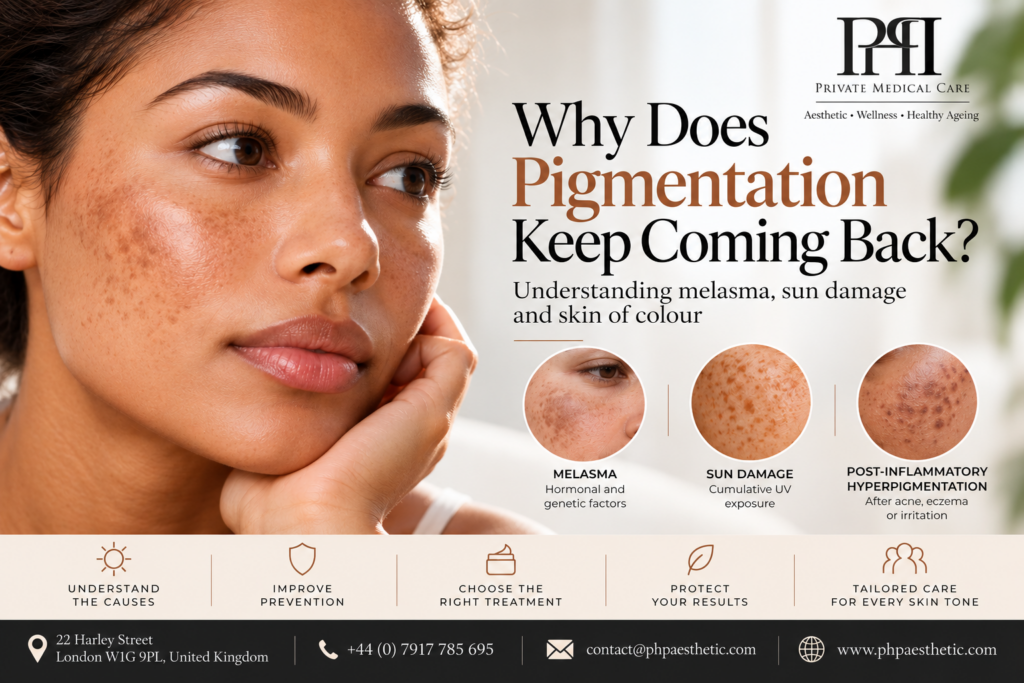
Why dark patches return even after treatment, and what really helps maintain a clearer, more even complexion.
You may have spent months treating dark patches on your face, finally noticed an improvement, and then watched the pigmentation gradually return.
Perhaps the marks reappeared after a summer holiday, a hormonal change or even a new skincare product. It can feel frustrating, particularly when you have invested time and money in treatments that initially seemed successful.
But recurring pigmentation does not necessarily mean your previous treatment failed. The real question is whether the underlying cause of the pigmentation has been addressed.
At PHP Aesthetic-Wellness, we believe that understanding the difference between melasma, sun damage and post-inflammatory hyperpigmentation is the starting point for appropriate treatment.
1. Not all pigmentation is the same
Although different pigmentation conditions can look similar, they develop through different mechanisms.
Melasma: when pigmentation becomes a recurring condition
Melasma commonly appears as symmetrical brown or grey-brown patches on the cheeks, forehead or upper lip. It can be associated with hormonal changes, pregnancy, certain hormonal medications, genetic susceptibility and exposure to sunlight.
Unlike an isolated sunspot, melasma is often a chronic condition with a tendency to recur. Even when pigmentation becomes much less visible after treatment, the skin may remain susceptible to the same triggers.
This explains why melasma is often better understood as a condition requiring long-term management rather than a problem that can always be permanently removed.
Sunspots: the cumulative effects of ultraviolet exposure
Sunspots, also called solar lentigines, tend to develop in areas that have received repeated sun exposure over many years. They are particularly common on the face, hands and décolletage.
Unlike melasma, individual sunspots can sometimes respond well to targeted treatment. However, continued ultraviolet exposure can lead to the development of new pigmentation.
Any new, changing or unusual pigmented lesion should be assessed before cosmetic treatment to exclude other skin conditions.
Learn more about our Sun Damage & Pigmentation Clinic.
Post-inflammatory hyperpigmentation: when the skin remembers inflammation
Post-inflammatory hyperpigmentation (PIH) develops after inflammation or injury to the skin. Common triggers include acne, eczema, insect bites, shaving irritation, burns and overly aggressive cosmetic treatments.
Once inflammation has subsided, dark marks may remain for weeks, months or sometimes longer. This is particularly relevant for people with medium to deeper skin tones, in whom pigmentary changes following inflammation may be more persistent.
For patients experiencing acne and the marks it leaves behind, our article How to Get Rid of Acne Scars explains related skin concerns. It is important to distinguish flat pigmentation marks from true changes in skin texture or scarring.
2. Why does pigmentation return after treatment?
Several mechanisms may explain recurrence.
Sun exposure remains one of the biggest contributors. Ultraviolet radiation stimulates melanin production. In susceptible individuals, relatively modest exposure may be enough to darken existing pigmentation. For melasma, visible light from the sun can also play a role.
Hormonal influences can persist. Pregnancy-related hormonal changes, certain contraceptives and other hormonal factors may contribute to melasma. Treating the visible pigmentation does not necessarily remove the underlying susceptibility.
Inflammation can restart the pigmentation cycle. Harsh exfoliation, irritating skincare, aggressive treatments or repeated breakouts can trigger further inflammation and post-inflammatory marks.
Some treatment plans focus on correction but neglect maintenance. Improvement during an intensive treatment programme does not mean that daily skincare and sun protection can immediately be discontinued. This is particularly important in melasma, where maintenance is often essential to preserving results.
3. Skin of colour: why treatment selection matters
Pigmentation conditions can affect every skin tone, but their appearance, persistence and response to procedures may differ.
In medium and deeper skin tones, inflammation or skin injury can produce pronounced post-inflammatory hyperpigmentation. This means that a treatment designed to improve pigmentation may occasionally make it worse if the skin is irritated or the procedure is unsuitable.
Chemical peels, microneedling and certain energy-based treatments require particular care in individuals susceptible to PIH.
However, skin tone alone does not determine treatment suitability. A proper assessment must also consider the diagnosis, skin history, existing inflammation, prior treatments and individual risk factors.
At PHP, our Skin of Colour Clinic focuses on the assessment of pigmentation and other skin concerns across diverse complexions.
The objective is not simply to reduce visible pigment, but to do so without creating additional inflammation or damage.
4. Is sunscreen enough to prevent pigmentation?
Sun protection is essential, but the formulation matters.
For most people, daily broad-spectrum SPF 30 or higher is an important starting point. For patients with melasma or persistent hyperpigmentation, clinicians may recommend SPF 50+ with strong UVA protection and a formulation that also protects against visible light.
This is where tinted sunscreens containing iron oxides can be particularly useful. Traditional sunscreen filters primarily address ultraviolet radiation, whereas iron oxides in tinted formulations can provide additional protection against visible light.
A 2026 international expert consensus on hyperpigmentation disorders reinforced the importance of comprehensive photoprotection, including protection against UVA and high-energy visible light.
Practical habits are equally important:
- Apply a sufficient amount of sunscreen each morning.
- Reapply regularly when outdoors, particularly after sweating or swimming.
- Seek shade during periods of strong sunlight.
- Use a suitable hat and other protective clothing.
- Avoid sunbeds.
- Choose skincare that does not cause persistent burning or irritation.
And remember: sun protection remains relevant in autumn and winter, even when temperatures are low.
5. Which skincare ingredients can help?
Effective skincare depends on identifying the type of pigmentation and choosing ingredients appropriate for the individual.
Azelaic acid
Azelaic acid is used in the management of acne and certain pigmentation conditions, including melasma and post-inflammatory hyperpigmentation. It can be particularly useful when pigmentation occurs alongside acne or inflammation.
Retinoids
Certain retinoids support epidermal cell turnover and are used in the management of acne, photoageing and pigmentation. However, they can cause dryness and irritation, and excessively aggressive use may aggravate skin problems rather than improve them.
Prescription retinoids require clinical assessment and are generally avoided during pregnancy.
Vitamin C
Selected topical vitamin C formulations may help improve aspects of uneven pigmentation and provide antioxidant support. However, effectiveness depends on the formulation, concentration and stability of the product.
Prescription depigmenting treatments
For appropriate patients, a prescribing clinician may consider prescription-only depigmenting creams, used alone or in combination. These medicines require appropriate supervision, should not be used indefinitely, and should never be bought from unreliable sources.
Some difficult cases may require additional specialist options.
The most effective routine is not necessarily the one with the greatest number of active ingredients. It is the one that addresses the diagnosis while remaining tolerable enough for consistent long-term use.
For a broader explanation of commonly used skincare ingredients, read our Skincare Ingredients Guide. You may also find our article Skincare as the Foundation of Aesthetic Medicine, Wellness and Healthy Ageing helpful.
6. Can chemical peels, microneedling or laser treatments remove pigmentation permanently?
Some procedures can improve selected pigmentation conditions, but they are not appropriate for everyone.
Chemical peels
Carefully selected peels may help certain superficial pigmentation concerns. However, the concentration, depth and type of peel must be chosen carefully, especially for patients at greater risk of post-inflammatory pigmentation.
Microneedling
Microneedling has been studied as an adjunctive treatment in some pigmentation protocols. However, its benefits depend on the indication and technique, and inappropriate treatment can cause inflammation or additional pigmentation.
Laser and light treatments
Certain laser and light-based treatments may improve selected pigmentation problems. Nevertheless, their use in melasma requires particular caution because relapse and treatment-induced hyperpigmentation can occur.
The best option depends on the diagnosis, not simply on which technology is newest. No procedure should be presented as a guaranteed permanent cure for melasma.
7. How long does it take to see improvement?
Pigmentation treatment requires patience. Some patients notice gradual improvement over a few months, while others need a longer course of management.
For melasma, the American Academy of Dermatology notes that results usually take around three to twelve months, and may take longer when melasma has been present for a long time.
The time required depends on the type and duration of pigmentation, the treatment selected, adherence to sun protection and individual skin response.
Photographic monitoring and regular reassessment can help determine whether a treatment plan is working or needs adjustment. Even after a good response, maintenance may remain necessary.
8. Five common mistakes that can make pigmentation worse
- Stopping sunscreen when the pigmentation fades. An improvement in appearance does not necessarily mean the skin has lost its susceptibility to pigmentation.
- Using too many exfoliating products. Repeated irritation may worsen post-inflammatory hyperpigmentation.
- Treating all dark patches as melasma. Different conditions require different approaches. Unusual or changing lesions may need medical assessment.
- Expecting immediate results. Pigmentation frequently responds gradually, and over-treatment can be counterproductive.
- Choosing procedures without considering skin tone and inflammation risk. An individualised assessment is especially important when the skin has previously developed dark marks after irritation or treatment.
9. When should you seek a professional skin assessment?
Consider an assessment if pigmentation is persistent, repeatedly returns, is associated with ongoing acne or inflammation, or has not improved with an appropriate skincare routine.
You should also seek medical advice for a new, changing, irregular, bleeding or otherwise concerning pigmented lesion rather than assuming it is cosmetic pigmentation.
A consultation can help distinguish common pigmentation disorders and establish whether skincare, prescription treatment, a procedure or specialist referral is appropriate.
Learn more about our Dermatology Consultation and Skin Health Services.
The PHP perspective: treat the cause, not just the colour
At PHP Aesthetic-Wellness, we believe that pigmentation management begins with understanding the skin. A dark patch may be related to hormonal influences, ultraviolet exposure, inflammation or several contributing factors.
Successful care is therefore rarely about a single product or procedure. It involves an accurate assessment, realistic expectations, appropriate treatment selection and a maintenance plan tailored to the individual.
The goal is not simply brighter-looking skin today. It is healthier skin and better-informed decisions for the years ahead.
Further reading and scientific references
British Association of Dermatologists. Melasma: patient information leaflet (June 2024).
skinhealthinfo.org.uk
American Academy of Dermatology. Melasma: diagnosis and treatment.
aad.org
Passeron T, Desai SR, Abdallah M, et al. (2026). Global consensus on the management of melanin hyperpigmentation disorders. Journal of the European Academy of Dermatology and Venereology.
doi.org/10.1111/jdv.70185
Zhou C, Lee C, Salas J, Luke J (2024). Guide to tinted sunscreens in skin of color. International Journal of Dermatology 63(3):272–276.
pubmed.ncbi.nlm.nih.gov/38073075
This article provides general patient education and is not a substitute for an individual clinical diagnosis or treatment plan. Individual responses to treatment vary.
Book a skin assessment
PHP Aesthetic-Wellness, 22 Harley Street, Suite 8, London W1G 9PL
Defined by Paris · Refined by Seoul · Excellence on Harley Street
+44 (0) 7917 785 695 · contact@phpaesthetic.com