Cupping Therapy for Healthy Ageing
Cupping Therapy for Healthy Ageing
An ancient practice with a modern following — here’s how cupping actually works, what the research does and doesn’t show, and how it fits into a considered approach to recovery, mobility and healthy ageing.
14 min read•
Evidence-reviewed
Few wellness therapies are as instantly recognisable as cupping. The round, ruddy marks it leaves have appeared on the shoulders of Olympic swimmers, elite footballers and A-list actors — and behind that striking image sits a treatment used for thousands of years across Egyptian, Chinese, Middle Eastern and Greek medicine. Today, physiotherapists, acupuncturists and sports-medicine practitioners use it to ease muscular tension, support recovery and improve how the body moves.
This guide takes a clear-eyed, balanced look at cupping: what it is, the different types, the mechanisms practitioners describe, and — importantly — what the current scientific evidence genuinely supports versus where the picture is still uncertain. We’ll also cover who cupping is suitable for, who should avoid it, and how it can complement a broader healthy-ageing routine focused on movement, circulation and recovery.
01What is cupping therapy?
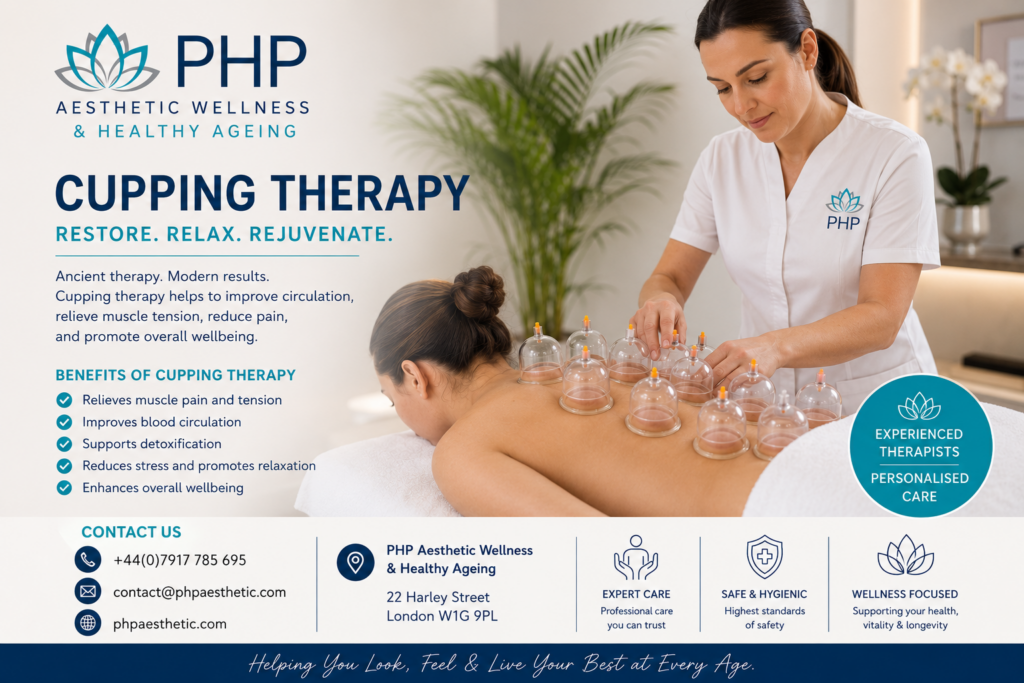
Cupping therapy is a form of complementary treatment in which a practitioner places specially designed cups on the skin and creates a partial vacuum inside them. That suction gently lifts the skin and the superficial layers of soft tissue up into the cup — essentially the opposite of the downward pressure you’d feel in a conventional massage.
The suction can be produced in a few different ways: by briefly heating the air inside a glass cup with a flame (fire cupping), by squeezing a flexible silicone cup, or by drawing air out with a hand-held or mechanical pump. Cups are typically left in place for a few minutes, or glided across oiled skin for a massage-like effect. The result is increased local blood flow to the area and a distinctive sensation of tightness and release.
It’s best understood as a soft-tissue and circulatory therapy — a tool used alongside massage, movement and rehabilitation rather than a stand-alone cure for any specific disease.
02A brief history
Cupping is one of the oldest documented therapies in the world. References appear in the Ebers Papyrus of ancient Egypt (around 1550 BCE), in classical Chinese medical texts where it became a pillar of Traditional Chinese Medicine, and in the writings of Greek physicians such as Hippocrates. Variations developed independently across the Middle East, Asia and Europe, where it was often paired with bloodletting or used to “draw out” illness.
What has changed is the framing. Where traditional systems described cupping in terms of energy, “qi” and the balancing of humours, modern practitioners tend to describe it in terms of blood flow, fascia, the nervous system and muscle recovery. The technique endured; the explanation evolved.
03How cupping is thought to work
It’s worth being honest here: the precise mechanisms behind cupping are still not fully established, and researchers who review the field openly acknowledge this. That said, several plausible, physiology-based explanations are proposed for the effects people report.
Increased local blood flow and microcirculation
The negative pressure draws blood toward the surface of the skin, dilating small blood vessels in the treated area. Proponents suggest this boost in local circulation may help deliver oxygen and nutrients to tissue and support the clearing of metabolic waste — one reason cupping is popular for tired, overworked muscles.
Nitric oxide and vasodilation
Suction is thought to stimulate the release of vasodilators such as nitric oxide from the cells lining blood vessels, which widens vessels and further encourages blood flow to the region.
Fascia and connective tissue
By lifting and separating the layers of skin, fascia and muscle, cupping may help mobilise connective tissue that has become restricted or “stuck,” potentially easing stiffness and improving range of motion. This is a key reason movement and sports-medicine practitioners incorporate it.
The pain “gate” and the nervous system
Cupping may influence pain perception through the gate-control theory — the idea that stimulating sensory nerves can dampen the transmission of pain signals. Many people also find the treatment deeply relaxing, which points to a calming, parasympathetic nervous-system effect that can reduce the muscular guarding that accompanies chronic tension.
You’ll sometimes see cupping described as “removing toxins.” This is a traditional framing rather than a physiologically proven mechanism — the body’s detoxification is handled by the liver and kidneys. It’s more accurate, and more honest, to talk about improved local circulation and soft-tissue mobility than “flushing out toxins.”
04The main types of cupping
Not all cupping is the same. The technique you’ll encounter depends on the practitioner, your goals and the tradition they work within.
Dry cupping Most common
The standard Western approach. Cups are applied to create suction and left in place, typically for around 5–10 minutes, with no breaking of the skin. Simple, non-invasive and the most frequently studied form.
Massage / gliding cupping Mobility
Oil is applied and the cups are slowly moved across the body while maintaining suction, combining the lift of cupping with the flow of a deep-tissue massage. Favoured for broad areas of muscular tension and fascial restriction.
Fire cupping Traditional
The classic method: a flame briefly heats the air inside a glass cup, which is then placed on the skin. As the air cools it contracts, creating the vacuum. Performed by trained practitioners, with the flame never touching the body.
Silicone & pump cupping Modern
Flexible silicone cups (squeezed to create suction) or plastic cups with a hand-pump valve allow precise, adjustable pressure without heat. Comfortable, easy to control, and well suited to sensitive areas and facial work.
Facial cupping Aesthetic
Very small, gentle cups used with light suction on the face to encourage circulation and lymphatic movement. A soft, non-marking technique often included in aesthetic and healthy-ageing skincare routines.
Wet cupping (Hijama) Specialist
After initial suction, the practitioner makes tiny superficial skin incisions and reapplies the cup to draw out a small amount of blood. This is an invasive technique that requires strict hygiene and specialist training, and is not offered in every clinic.
05What the science actually shows
Cupping has a large and enthusiastic following, and a growing body of research — but it’s important to represent that research accurately rather than overselling it. Here is the balanced picture as it stands.
The encouraging side: Multiple systematic reviews report that cupping may help reduce pain and improve function for certain musculoskeletal complaints, with the most consistent signals seen for neck pain and non-specific low back pain. Compared with no treatment or usual care, cupping often comes out ahead for short-term pain relief, and it performs broadly similarly to some other manual therapies. Reported satisfaction and relaxation are frequently high.
The important caveats: The quality of the underlying evidence is generally low to moderate. Many trials are small, differ widely in technique, and struggle to use a convincing “placebo” cup — which makes it genuinely difficult to separate a specific treatment effect from expectation and hands-on attention. One 2025 systematic review with meta-analysis concluded that, compared with a sham/placebo cup, the evidence for dry cupping in musculoskeletal pain is very uncertain across short, medium and long-term follow-up. Reviewers across the field consistently call for larger, higher-quality studies.
A simplified reading of where the research currently sits. “Certainty” reflects the overall quality and consistency of studies, not a guarantee of results for any individual.
The honest summary: cupping is low-risk, widely used, and many people find it genuinely helpful for muscular pain and tension — but current high-quality evidence can’t yet confirm it outperforms a convincing placebo. It’s best viewed as a supportive, complementary therapy, not a proven medical treatment.
— The balanced, research-informed view
06Conditions it is commonly used for
In practice, cupping is used by acupuncturists, physiotherapists and sports-medicine practitioners to address a broad range of musculoskeletal and systemic concerns, including:
- Chronic back, neck and shoulder pain
- Muscle tension, soreness and fatigue — particularly in athletes
- Fascial restriction and reduced range of motion
- Inflammation and joint stiffness (including arthritis and fibromyalgia)
- Headaches and migraines
- Sports recovery and performance optimisation
- Skin and circulatory conditions where improved blood flow is beneficial
“Commonly used for” describes how practitioners apply cupping — it is not a claim that cupping treats or cures these conditions. If you have a medical condition, cupping should complement, not replace, care from your healthcare provider.
07Cupping & healthy ageing
Healthy ageing isn’t about any single therapy — it’s about consistently supporting the systems that keep us mobile, resilient and comfortable over the decades. Circulation, soft-tissue quality and recovery capacity all tend to decline with age, and this is where a therapy like cupping can play a supportive, complementary role.
For people who train hard or spend long hours at a desk, cupping offers a way to address the muscular tension and fascial stiffness that accumulate over time — helping maintain range of motion and comfort. For those focused on longevity and performance, it’s one recovery tool among many (alongside sleep, mobility work, resistance training and good nutrition) that can help the body bounce back and keep moving well. And facial cupping, with its focus on circulation and lymphatic flow, has become a gentle fixture in aesthetic, ageing-well skincare routines.
The key is realistic framing: cupping supports how you feel and move; it works best as part of a broader, evidence-led approach to ageing well rather than as a stand-alone intervention.
08What to expect in a session
-
Consultation
Your practitioner reviews your health history, medications and goals, and checks for any reasons cupping wouldn’t be suitable (see the safety section below).
-
Preparation
You’ll settle comfortably, usually lying down, with the treatment area exposed. For gliding techniques, a light oil is applied to the skin.
-
Application
Cups are placed and suction is created. You’ll feel a firm tightness or pulling — most people find it oddly satisfying rather than painful. Cups are either left in place or moved slowly across the area.
-
Removal & rest
After a few minutes the cups are released. You may notice circular marks and a pleasant sense of looseness or warmth in the area.
-
Aftercare guidance
Your practitioner will advise on hydration, keeping the area warm, and when to book any follow-up.
09Understanding the marks
Those famous circular marks are the single most misunderstood thing about cupping. They are not bruises in the usual sense — there’s no impact or crushing of tissue. Instead, the suction draws blood toward the skin’s surface, and some of it settles in the tissue, producing a temporary discolouration that can range from light pink to deep purple depending on the individual and the area.
The marks are generally painless and are considered a normal, expected response to the treatment. They typically fade within a few days to about a week as the body reabsorbs the pooled blood — much like any minor mark. Darker marks don’t necessarily mean a “better” treatment; colour varies from person to person.
10Aftercare & getting the most from it
A few simple habits help you get the most from a session and keep the skin happy afterwards:
- Drink plenty of water and rest for the remainder of the day where you can
- Keep the treated area warm and covered; avoid extremes of temperature, saunas, hot tubs and vigorous exercise for a few hours
- Protect any marked skin from strong sun until it fades
- Avoid harsh scrubbing or exfoliating the area for a day or two
- Expect the marks to fade over several days — and don’t worry if you feel a little tired or mildly sore initially
11Who should avoid cupping
Cupping is not suitable for everyone. Avoid it, or consult a healthcare provider first, if you have:
- Bleeding disorders, or you are taking blood-thinning medication
- Active skin infections, open wounds, or burns
- Severe skin sensitivity
- Pregnancy
Cupping should also not be performed over areas of acute inflammation. As a general precaution, people with cancer, organ failure, blood-clotting disorders, cardiovascular disease, or those with a pacemaker should seek medical advice before considering cupping.
Side effects
For most people, side effects are mild and self-limiting: temporary skin discolouration, slight soreness, and occasional lightheadedness, all of which typically resolve within a few days. Less commonly, and mainly with heat- or incision-based techniques performed poorly, there is a risk of burns, skin irritation or infection — which is why choosing a trained, hygienic practitioner matters enormously. If you ever experience severe pain, blistering, signs of infection, or symptoms that concern you, contact a healthcare professional.
12Frequently asked questions
Does cupping therapy actually work?
Cupping is widely used for musculoskeletal pain, muscle tension and recovery, and many people report meaningful relief and relaxation. The research is promising but mixed: reviews suggest possible short-term benefit for conditions such as neck and low back pain, but most studies are small and of low-to-moderate quality, and the effect over a convincing placebo remains uncertain. It’s best viewed as a low-risk, supportive therapy rather than a proven cure.
Does cupping hurt?
Most people describe a firm tightness or pulling sensation rather than pain. Moving (massage) cupping can feel like a deep-tissue massage. Any soreness afterwards is usually mild and short-lived.
Do the marks mean something is wrong?
No. The circular discolouration is caused by suction drawing blood toward the surface of the skin — it isn’t an impact bruise, and it’s usually painless. Marks typically fade within a few days to about a week.
How often should I have cupping?
It depends on your goals. For a specific issue, a short course of weekly sessions is common; for maintenance, recovery or general wellbeing, many people book every two to four weeks. Your practitioner will tailor a plan and usually waits for previous marks to fade before re-treating the same area.
How long do the marks last?
Usually a few days up to around a week, depending on the individual, the area treated and the strength of suction used. Staying hydrated and keeping the area protected can help.
Can I combine cupping with massage or physiotherapy?
Yes — cupping is frequently used alongside massage, movement work and rehabilitation, and many practitioners integrate it into a broader treatment plan. Always let each practitioner know what other treatments you’re receiving.
Considering cupping as part of your recovery routine?
At PHP Aesthetic Wellness, we take a considered, evidence-informed approach to healthy ageing — pairing therapies like cupping with honest guidance about what will genuinely help you move and feel better. Book a consultation and we’ll build a plan around your goals.
Sources & further reading
- Update evidence of effectiveness on pain relieving of cupping therapy: a systematic review and meta-analysis of RCTs — PMC, 2025
- The Efficacy of Dry Cupping Compared to Placebo Cupping for People With Musculoskeletal Complaints: A Systematic Review With Meta-Analysis — JOSPT Open, 2025
- Systematic review found dry cupping vs placebo for musculoskeletal pain is very uncertain — PEDro summary
- Effectiveness of cupping therapy for musculoskeletal pain: an umbrella review — Human Movement
- Cupping Therapy — StatPearls, NCBI Bookshelf
- What Is Cupping Therapy? Uses, Benefits, Side Effects — WebMD
- How Does Cupping Work? Mechanisms of Action Explained — Massage Magazine