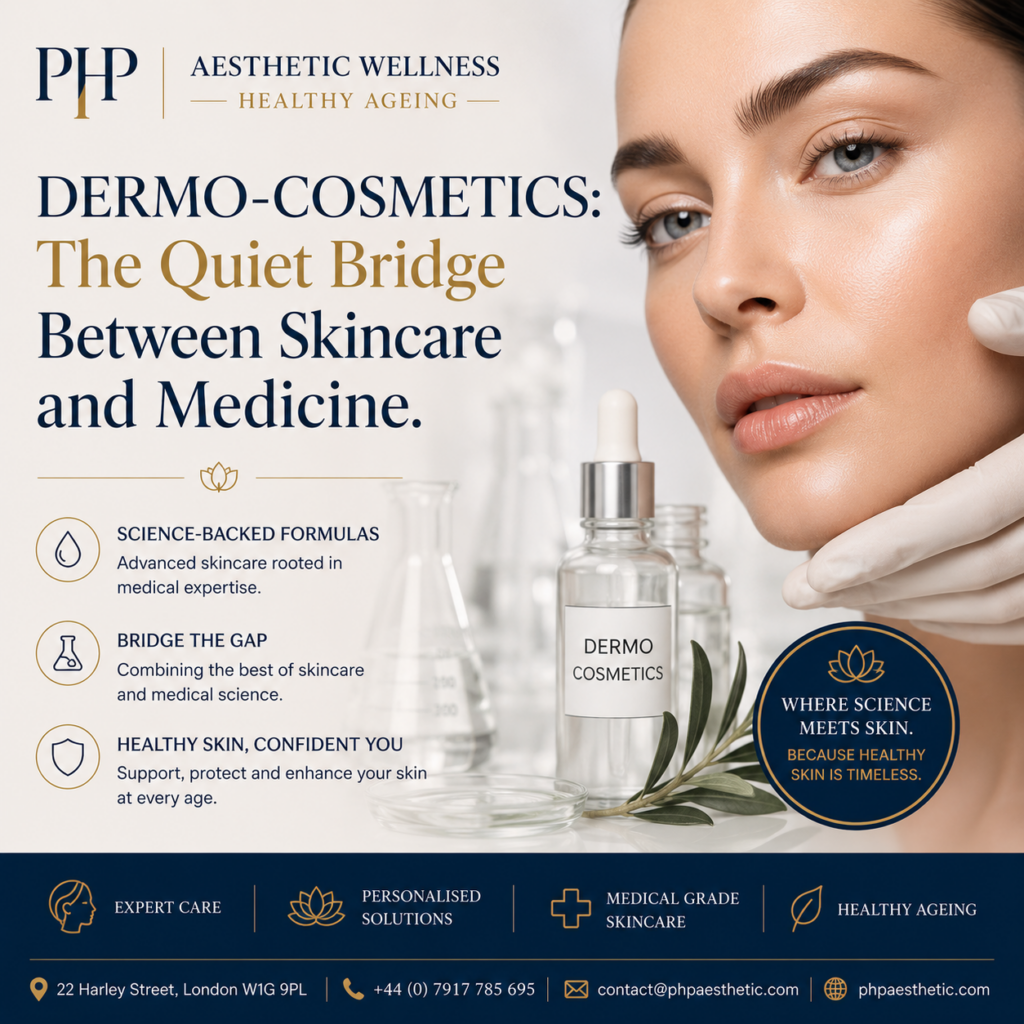
Dermo-Cosmetics: The Quiet Bridge Between Skincare and Medicine
PHP
Aesthetic-Wellness
Insights & Patient Education
Dermo-Cosmetics: The Quiet Bridge Between Skincare and Medicine
Not quite a cosmetic. Not a medicine, either. Here’s why this in-between category deserves far more attention than it gets in aesthetic, wellness, and longevity practice.
Most patients sort skincare into two boxes: things you buy at a beauty counter, and things a doctor prescribes. Dermo-cosmetics don’t fit neatly into either box, and that’s precisely what makes them useful — and precisely why they deserve a more deliberate place in clinical practice than they usually get.
What Dermo-Cosmetics Actually Are
Dermo-cosmetics, sometimes called cosmeceuticals, are topical products containing active ingredients capable of genuinely influencing the skin’s biology, rather than simply sitting on the surface for cosmetic effect. They sit in a deliberate regulatory middle ground: under European cosmetics regulation, they’re permitted to make functional claims about how the skin behaves, but they’re not allowed to be marketed as medicines that treat or cure disease, even though many of them are developed in close collaboration with dermatologists and contain clinically tested actives.
This isn’t a loophole or a marketing trick, even though the category has occasionally been accused of being exactly that. It’s a genuine, useful third category, sitting between an ordinary moisturiser and a prescription cream, and it exists because a great deal of skin support doesn’t actually require a prescription-strength intervention to be effective — it requires the right active ingredient, at the right concentration, used consistently.
The Evidence Is More Substantial Than Many Assume
This is worth stating plainly, because the category attracts real scepticism, some of it deserved when products overreach on their claims. But the clinical evidence in certain areas has become genuinely strong. Acne is the clearest example: a 2026 review concluded dermocosmetics can function as a standalone treatment for mild acne and as a valuable add-on therapy in mild-to-moderate cases, particularly when a tailored cleanser, an acne-appropriate moisturiser, and proper sun protection are combined as a routine rather than used in isolation. A multicentre study of around 100 patients found that adding a specific dermocosmetic cream alongside standard acne treatment produced a significantly greater improvement on a recognised acne severity scale than standard treatment alone.
The category has also found a genuinely important role in cancer care. Many cancer treatments, including chemotherapy, targeted therapies, and radiotherapy, cause significant skin toxicity, and dermocosmetics are now used internationally, with expert consensus support, to help prevent and manage these skin reactions — not as a cosmetic afterthought, but as a meaningful part of keeping a cancer patient comfortable enough to continue their treatment without interruption.
A product doesn’t need to be a prescription medicine to be clinically meaningful. It needs the right evidence behind it, used the right way.
Why This Matters Specifically Across Aesthetic, Wellness, and Longevity Practice
This is where the category becomes genuinely important to how a clinic like ours thinks about a patient’s overall plan, rather than treating it as a side note to in-clinic procedures.
Aesthetic Medicine
The right dermo-cosmetic routine extends and protects the result of an in-clinic procedure — supporting barrier recovery after a peel or microneedling session, or maintaining skin quality between treatments rather than relying on the procedure alone to do all the work.
Wellness
Skin condition is one of the most visible, daily-felt indicators of how someone is doing more broadly. A well-chosen dermo-cosmetic routine is a low-risk, high-consistency way to support skin health between consultations, without requiring a clinical intervention every time something needs addressing.
Longevity
This is daily, cumulative, barrier-focused care — exactly the kind of consistent, low-intensity intervention that genuinely matters over years rather than weeks, fitting naturally alongside the broader longevity principle of prevention over correction.
Why a Recommendation Should Come From a Consultation, Not a Shelf
The scale of this market is worth knowing, because it explains why discernment matters so much here. Dermocosmetics have become a genuinely large global category, with some markets reporting tens of millions of units sold and prescribed annually through pharmacies alongside ordinary retail channels. That scale brings real innovation, but it also brings a flood of products making similar-sounding claims with very different levels of evidence behind them.
A recent academic review of dermatologist-recommended cosmetic labels found exactly the problem you’d expect at that scale: real inconsistency in how clearly, and how scientifically, claims were communicated to both patients and the clinicians recommending them. This is precisely why we treat dermo-cosmetic recommendations as a genuine clinical decision, not a retail upsell — matched to your specific skin, your current treatment plan, and the evidence behind the specific active ingredient, rather than handed out generically because a product is popular or heavily marketed.
Where this shows up at PHP
Our Medi-Cosmetics Consultation exists for exactly this reason — a dedicated appointment to assess your skin properly and build a dermo-cosmetic routine around evidence and your actual needs, rather than trial and error at a pharmacy shelf or a generic online recommendation.
Every consultation includes
3D LifeViz imaging by Quantificare
, giving a precise, objective picture of your skin and letting us visualise the projected outcome together — so decisions are based on clear evidence you can actually see, not guesswork.
The Honest Summary
Dermo-cosmetics occupy a genuinely useful space precisely because they’re not trying to be a medicine, and they’re not pretending to be an ordinary cosmetic either. Used well, with the right active ingredient matched to the right concern and used consistently, they do real, evidenced work supporting skin health between clinical treatments, across exactly the kind of long-term, prevention-focused thinking that aesthetic, wellness, and longevity medicine all increasingly share. Used carelessly, picked off a shelf based on packaging alone, they’re little more than an expensive moisturiser. The difference, as with most things in this field, comes down to whether the recommendation was built around evidence or around marketing.
Further Reading
Authoritative sources on the evidence, regulation and clinical role of dermo-cosmetics.
- Dréno B, et al.
Reviews on the role of dermocosmetics as an adjunct in the management of acne — among the most widely cited work on dermocosmetics in acne care.
Journal of the European Academy of Dermatology and Venereology (JEADV). - Multinational Association of Supportive Care in Cancer (MASCC).
Oncodermatology consensus guidance on preventing and managing skin toxicity from chemotherapy, targeted therapy and radiotherapy. - Kligman AM.
Foundational work introducing the concept of the “cosmeceutical” — the origin of the category discussed here. - Regulation (EC) No 1223/2009 on Cosmetic Products.
The European framework that permits functional claims while prohibiting medicinal claims — the regulatory middle ground described above. - British Association of Dermatologists (BAD)
and
European Academy of Dermatology and Venereology (EADV)
. Patient-facing and professional guidance on evidence-based skincare and cosmeceutical actives.