
LPG Endermologie: A Doctor-Led Guide to Skin Quality, Body Contouring and Recovery
Skin Quality · Body Contouring · Healthy Ageing
LPG Endermologie: A Doctor-Led Guide to Skin Quality, Body Contouring and Recovery
A balanced look at what LPG endermologie does inside the skin, what the published measurements actually show for the body, the face and for stress and sleep, and where a mechanical treatment sensibly fits alongside injectable and energy-based work.
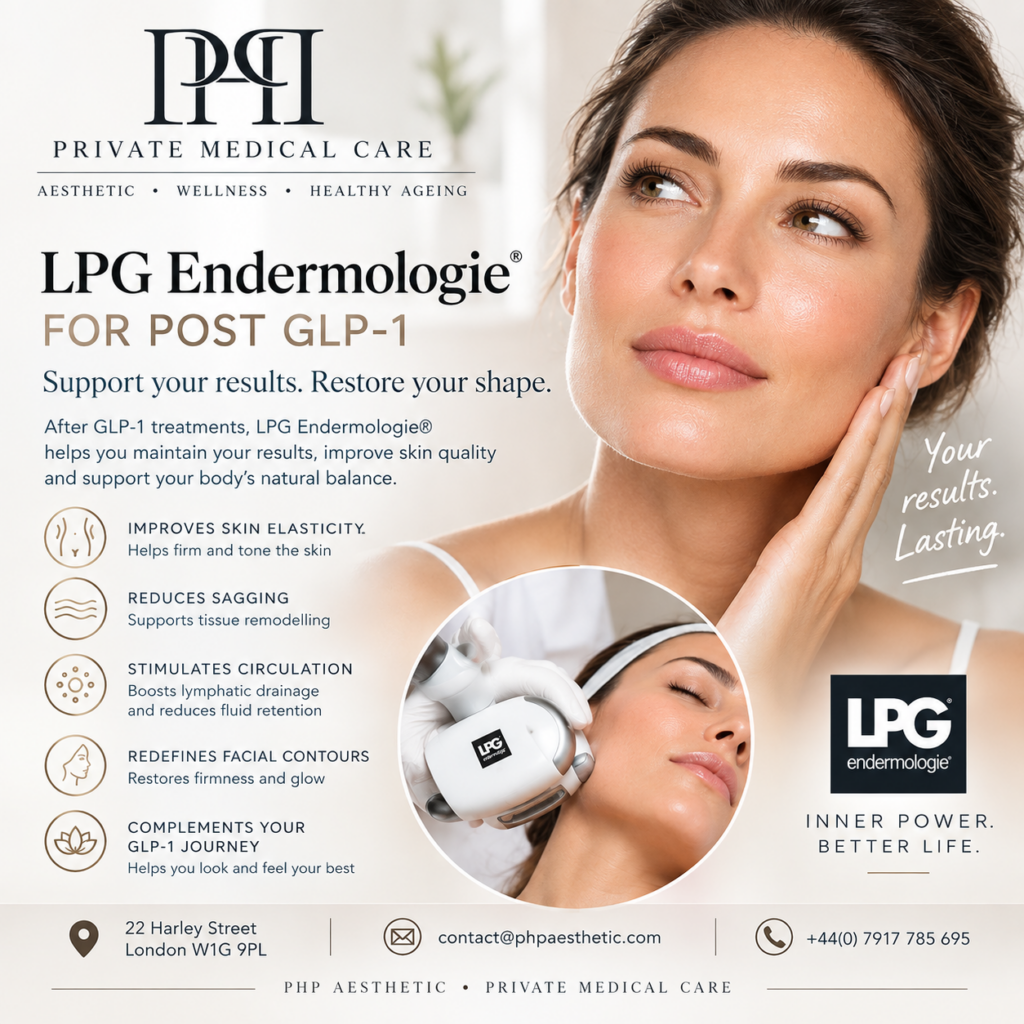
LPG endermologie is a mechanical treatment. A motorised head lifts and rolls the skin and the tissue beneath it; nothing is injected, nothing is heated, and there is no recovery period. That simplicity is easy to underestimate, and it is precisely why the treatment is often filed under aftercare or massage rather than assessed on its own terms.
It deserves better than that, for one reason: the effects have been measured. Not only by patient satisfaction questionnaires, but by skin biopsy, ultrasound imaging of the dermis, DEXA body composition scanning, salivary cortisol and blood markers. This guide sets out what those measurements show, what they do not show, and who the treatment genuinely suits.
What the treatment actually does to the skin
Young skin is a lattice under tension. Collagen fibres are ordered and interwoven, and the fibroblasts living among them are spread, anchored and mechanically loaded, which is the state in which a fibroblast synthesises new tissue. Mechanical tension is not a by-product of healthy skin; it is part of the instruction the cell receives.
With age, those fibres fragment. The fibroblast loses its attachments, collapses inward and stops being stretched. An unloaded fibroblast produces less collagen and more matrix metalloproteinase-1, the enzyme that degrades collagen, which fragments more fibres, which unloads the cell further.
1
It is a self-reinforcing loop, and it is the same loop that
chronic inflammation
feeds from the other direction.
This also explains why more collagen is not automatically better collagen. Scar tissue contains more collagen than young skin, laid down in thick parallel bundles: abundant, stiff, and not functioning as skin. The useful clinical question is not how much collagen is present, but what kind of network it forms and whether anything is still pulling on the cell.
Controlled mechanical deformation is the one input that interrupts the loop, and it is the only input this device provides.
Fisher and Varani’s work on the unloaded fibroblast, and Qin et al’s demonstration that reduced cellular spreading up-regulates MMP-1 via c-Jun/AP-1 in human dermal fibroblasts, provide the mechanistic rationale here.
1
Senescent dermal fibroblasts generate less contractile force and remodel matrix poorly, and matrix stiffness feeds back on whether fibroblasts become senescent at all.
2
Endermologie’s sole input is controlled mechanical deformation of exactly the tissue whose mechanical competence is failing. That is a coherent rationale to put in front of a patient, it is not, and should not be presented as, evidence that the treatment clears senescent cells.
Is the mechanism proven, or is it manufacturer science?
It is a fair question to ask of any device-led treatment, and the answer is stronger than the marketing around this category usually makes it sound.
The principle does not belong to LPG. Fibroblast mechanotransduction is studied independently of this device, and independently of aesthetic medicine altogether; it is the same biology that explains why bone responds to weight-bearing and tendon to progressive loading. A cell that stops being pulled on stops behaving like a working cell.
The most useful trial conducted on the device itself was double-blinded, randomised and split-face: thirty subjects aged 35 to 50 with mild-to-moderate facial sagging, twenty-four sessions across eight weeks, each subjects untreated side serving as their own control, with the authors declaring no conflict of interest with any financial organisation. Fibroblasts taken from the treated side showed significantly greater migratory capacity than those from the control side (p<0.001), alongside a significant increase in MMP-9 synthesis.
7
Confirmation of the mechanism arrives from an unrelated direction entirely. Working with a different device, a different manufacturer and a different research group, a study of 121 human skin explants found that mechanical stimulation at 75 Hz maximised expression of procollagen-1, tropoelastin, fibrillin and decorin, and reinforced the dermal epidermal junction.
8
Two manufacturers with no shared interest, arriving at the same underlying biology. That convergence is what makes the rationale credible rather than promotional.
The significant findings in the split-face study were cellular rather than cosmetic. The clinical sagging score improved on 73% of treated sides against 53% of control sides, which did not reach significance (p=0.108), and the increases in collagen I and elastin were non-significant across eight weeks.
7
A 2024 systematic review of cellulite modalities identified only two randomised trials of mechanical massage and did not place it among the best-evidenced options for that indication.
9
The honest summary is that the cellular response is currently better documented than the visible endpoint, and that a rise in MMP-9 describes remodelling rather than accumulation which is also the most plausible explanation for results that continue to develop after a course has finished.
What was measured on the body
In an evaluation of 28 women who completed 12 sessions of 40 minutes, twice weekly over six weeks:
3
- Circumference reduced
waist -5.8 cm, hips -4.4 cm, thighs -2.4 cm. - Abdominal fat fell by 4.3%
, measured by DEXA scan rather than tape measure. - Cellulite improved by one to two grades
, with 93% of women reporting visibly smoother skin. - Heavy legs improved after a single session
the heavy, swollen sensation reduced by half, with blood flow through the tissue up 14.7%. - Overall satisfaction was 86%
after the full course.
The leg result is the one patients notice first, often after the very first appointment, because drainage responds immediately while dermal change takes a course of sessions to build.
Firmness, and what the ultrasound showed
Circumference is the easy measurement, and the one every
body contouring
treatment quotes. Skin quality is the measurement that decides whether a result actually looks good. Ultrasound imaging showed the dermis becoming denser rather than merely tighter, with the dark, non-echogenic zones on the scan shrinking as collagen production increased:
- Dermal density increased
by 5.3% at the knees, 8.9% at the abdomen, 14% at the thighs and 14.1% at the buttocks. - 92% of women reported firmer skin
after 12 sessions and 46% already reported it after three. - Results continued to improve after treatment stopped.
One month after the final session, firmness measurements had risen further: +21.3% at the waist, +26.3% at the buttocks, +23.2% at the knees.
That last finding is the most clinically interesting of the three. A result that holds and improves without further sessions is what you would expect if the tissue behaviour had changed, rather than fluid having been temporarily displaced. It is also the practical argument for completing a course rather than abandoning it halfway.
LPG endermologie for the face
The same mechanical stimulation is applied to the face using a finer head. Biopsy studies of treated facial skin found a clear fibroblast response: endogenous hyaluronic acid production doubled, natural elastin synthesis rose by 46%, and the collagenic action contributing to dermal density was reported at +240%.
4
In practice this shows as softened fine lines, better definition along the facial oval and jawline, and brighter, less
dull or tired skin
. Nothing has been injected: the hyaluronic acid is the patient’s own.
The published evidence base covers cellulite, circumference and skin parameters; it is mechanistic rationale supported by clinical experience, and is strongest when presented as such.
The effect patients do not expect: cortisol, sleep and vitality
A controlled evaluation examined something other than appearance. Twenty-nine adults with measured stress and disturbed sleep (entry criteria: perceived stress score above 13, insomnia severity index above 7) received ten sessions of 40 minutes, twice weekly. The control group received the identical protocol with only the aspiration switched off.
6
- Salivary cortisol fell 19% after a single session.
- Vitality rose 76.6%
and perceived stress fell 50.9% over ten sessions. - Anxiety fell 69%
and insomnia severity fell 44.6%. - Muscular pain fell 54.7%
, concentration rose 6%, and heart-rate variability improved. - T lymphocytes rose 9.4%
, a marker of natural defences.
Cortisol is worth dwelling on, because it is the hormone that ages people quietly. It spares fat and mobilises protein, so lean tissue is the currency it spends. It disrupts sleep, and poor sleep raises it again the loop closes on itself, much as the collagen loop does. A flattened diurnal cortisol slope is increasingly discussed as a predictor of accelerated biological ageing, and cortisol and heart-rate variability are markers that
healthy ageing
programmes already measure routinely.
There is a practical consequence that matters more than it sounds. This is the one appointment in a treatment plan that patients actively look forward to, and adherence is what makes any programme work at all.
If you are losing weight quickly
Rapid weight loss, whether through dieting or a prescribed weight-loss treatment, addresses the number on the scale. It does not address the silhouette. Fat leaves faster than the skin envelope, the dermis and the lymphatic system can adapt to it, and sustained restriction raises cortisol at precisely the point where a patient most needs to feel well.
What tends to be left behind is a skin envelope sized for a larger body, facial volume loss and dermal thinning, interstitial fluid load, and uneven contour where fat has emptied asymmetrically. Those are tissue and recovery problems; neither is solved by the prescription. Endermologie occupies that gap, skin quality, tissue mobility, drainage and recovery alongside adequate protein and resistance training, which remain the only reliable levers on lean mass.
Endermologie does not build muscle and does not replace protein intake or resistance training. It is also not a weight-loss treatment: every figure quoted in this article is a quality-of-result measurement, not a measurement of weight. No controlled trial has yet been conducted in a post-GLP-1 population, and we would rather say so than imply otherwise.
Who it suits, and how a course is structured
Cellulite
, body contouring and loss of firmness
, particularly where skin quality matters as much as circumference.- Heavy, swollen legs and fluid retention
, where medically appropriate. - Facial skin quality
fine lines, loss of definition along the jaw, dull complexion. - Patients undergoing rapid weight loss
who want to protect the quality of the result. - Anyone who needs a regular treatment that lowers stress
rather than adding to it, as part of a longer-term
recovery
programme.
Results come from a course rather than a single session. The studies above ran ten to twelve sessions, twice weekly, which is what we recommend, followed by maintenance sessions to hold what has been built. Every course begins with an assessment, because the honest answer for some patients is that a different treatment will serve them better.
Prices
- Single session
£100 - Course of 5
£90 per session
450 - Course of 10
£80 per session, including consultation and body suit
800
Course offer ends 31 October 2026. Course sessions remain valid for 12 months from purchase. Full
treatment prices
are listed here.
Considering LPG endermologie, or unsure which treatment you need?
Book a doctor-led consultation to be properly assessed before committing to a course.
References
- Qin Z, Voorhees JJ, Fisher GJ, Quan T. Age-associated reduction of cellular spreading/mechanical force up-regulates matrix metalloproteinase-1 expression and collagen fibril fragmentation via c-Jun/AP-1 in human dermal fibroblasts.
Aging Cell.
2014;13(6):1028 1037. - Senescent dermal fibroblasts show reduced contractile force generation and impaired matrix remodelling.
Proc Natl Acad Sci U S A.
2023. - LPG Systems. Clinical evaluation of Endermologie® body treatment: 28 women, 12 sessions of 40 minutes over six weeks, with DEXA, ultrasound imaging and satisfaction measures. Data on file.
- Biopsy evaluation of the fibroblast response to Endermologie® facial treatment: endogenous hyaluronic acid, elastin and collagen synthesis. LPG Systems, data on file.
- Hamida-Pisal P. Combined treatment in aesthetic medicine using LPG endermologie for facial rejuvenation: a case series of 20 patients aged 30 75.
J Dermatol Cosmetol. - Hausswirth C. Controlled evaluation of the Endermologie® Vitality,“Stress”, Sleep protocol on salivary cortisol, heart-rate variability, perceived stress, insomnia severity, vitality, T lymphocytes, muscular pain and cognitive measures. n = 29 (14 active, 15 placebo without aspiration). Data on file.
- Humbert P, Fanian F, Lihoreau T, et al. Mecano-Stimulation of the skin improves sagging score and induces beneficial functional modification of the fibroblasts: clinical, biological, and histological evaluations.
Clin Interv Aging.
2015;10:387 403. - Caberlotto E, Ruiz L, Miller Z, Poletti M, Tadlock L. Effects of a skin-massaging device on the ex-vivo expression of human dermis proteins and in-vivo facial wrinkles.
PLOS ONE.
2017;12(3):e0172624. - Comparative analysis of cellulite treatment modalities: a systematic review.
Aesthetic Plast Surg.
2024.
This article is for general information and education only and does not constitute medical advice, diagnosis or treatment. The sources cited vary in strength and are identified in the text: references 1, 2, 7, 8 and 9 are independent and peer-reviewed, and reference 7 carries no declared conflict of interest with any financial organisation; reference 5 is our own published case series; references 3, 4 and 6 are manufacturer data. Individual results vary, and no treatment outcome can be guaranteed. Always seek personalised advice from a registered healthcare professional before starting any treatment.
Dr Philippe Hamida-Pisal
Founder, PHP Aesthetic-Wellness, 22 Harley Street, London. President, Society of Mesotherapy of the United Kingdom.
LPG®, Endermologie® and Cellu M6® are registered trademarks of LPG Systems.