Not All Collagen Is Created Equal: Why Quality Matters for Healthy Ageing
In the world of skincare and longevity, collagen has become something of a buzzword. We are told to boost it, build it, supplement it and stimulate it. And there is truth in that — collagen is the scaffolding that holds our skin firm, smooth and elastic.
But there is a crucial part of the story that often gets lost in the marketing: how much collagen you have matters far less than how well it is organised. A great deal of collagen, arranged badly, does not give you healthy, youthful skin. In fact, the clearest proof of this is something none of us would choose: scar tissue.
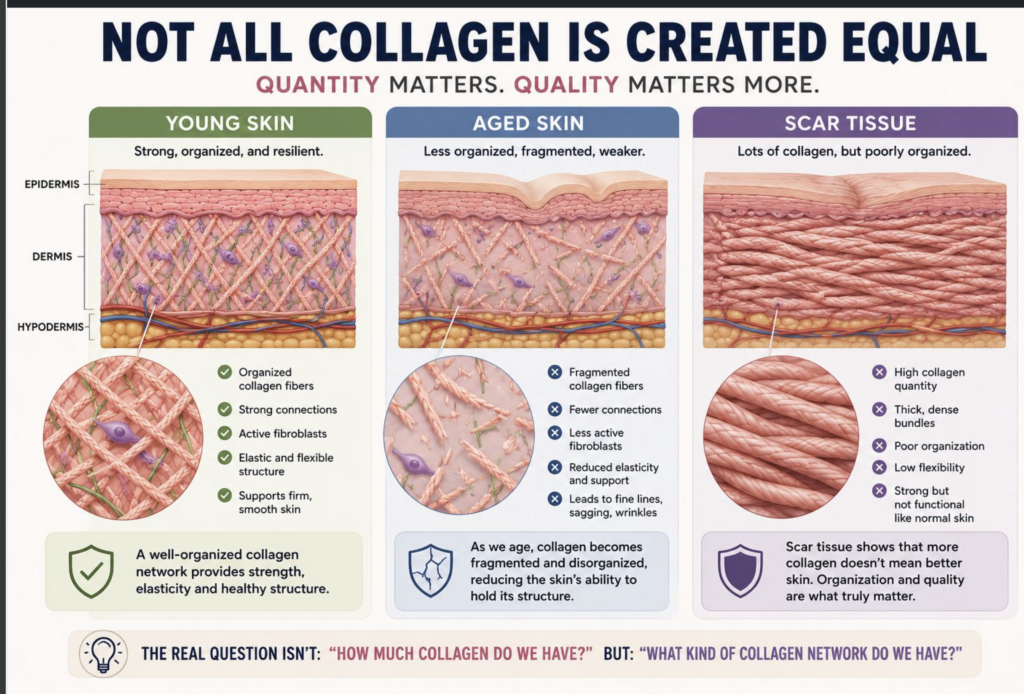
The real question isn’t “how much collagen do we have?” — but “what kind of collagen network do we have?”
Three kinds of collagen, three very different outcomes
1. Young skin — strong, organised, resilient
In young, healthy skin, collagen fibres are arranged in an organised, lattice-like network. The fibres are well connected, the fibroblasts (the cells that make collagen) are active, and the whole structure is elastic and flexible. This organisation is what gives young skin its firmness, its bounce and its ability to recover. It is not simply that there is more collagen — it is that the collagen is in the right places, doing the right job.
2. Aged skin — fragmented and disorganised
As we age, the picture changes. Collagen fibres become fragmented. There are fewer connections holding the network together, the fibroblasts become less active, and elasticity and support decline. The result is the familiar signs of ageing: fine lines, loss of firmness, sagging and wrinkles. Importantly, much of this is a story of disorganisation and fragmentation, not just of having “less” collagen.
3. Scar tissue — lots of collagen, poorly built
Here is the part that reframes everything. Scar tissue is often rich in collagen — thick, dense bundles of it. And yet scarred skin is not youthful, supple or healthy. It is stiff, poorly organised and does not function like normal skin. Scar tissue is the perfect illustration of the central truth: more collagen does not mean better skin. Organisation and quality are what truly matter.
Why this matters for longevity
Healthy ageing is not about chasing a single number or flooding the skin with raw material. It is about supporting the skin’s ability to build and maintain a well-organised collagen network over time — the kind that keeps skin functioning, not just filled.
This shift in thinking — from quantity to quality — changes the questions we ask. Instead of “how do I get more collagen?”, the better questions are: How do I support healthy, active fibroblasts? How do I encourage the skin to build organised, functional collagen rather than disordered bulk? And how do I protect the network I already have?
Much of that answer lies in the things that are not glamorous but are genuinely powerful: protecting skin from excessive sun and smoking (both of which fragment and damage collagen), supporting it with good nutrition and sleep, and managing the inflammation and stress that accelerate ageing. The treatments we offer in clinic work best as part of that bigger picture — supporting the skin’s own biology, not overriding it.
This is why, at PHP Aesthetic-Wellness, we talk about healthy ageing rather than anti-ageing. We cannot stop time. But we can help the skin age the way young skin is built to behave: organised, resilient, and functioning well — for as long as possible.
If you would like to understand your own skin’s long-term health, our doctor-led approach focuses on skin quality and healthy ageing — understanding your skin, not just treating its surface.
This article is for general information and education only. It is not medical advice, and individual results and circumstances vary. For advice specific to you, please arrange a consultation with a qualified practitioner.