Cupping therapy safety: why the setting matters
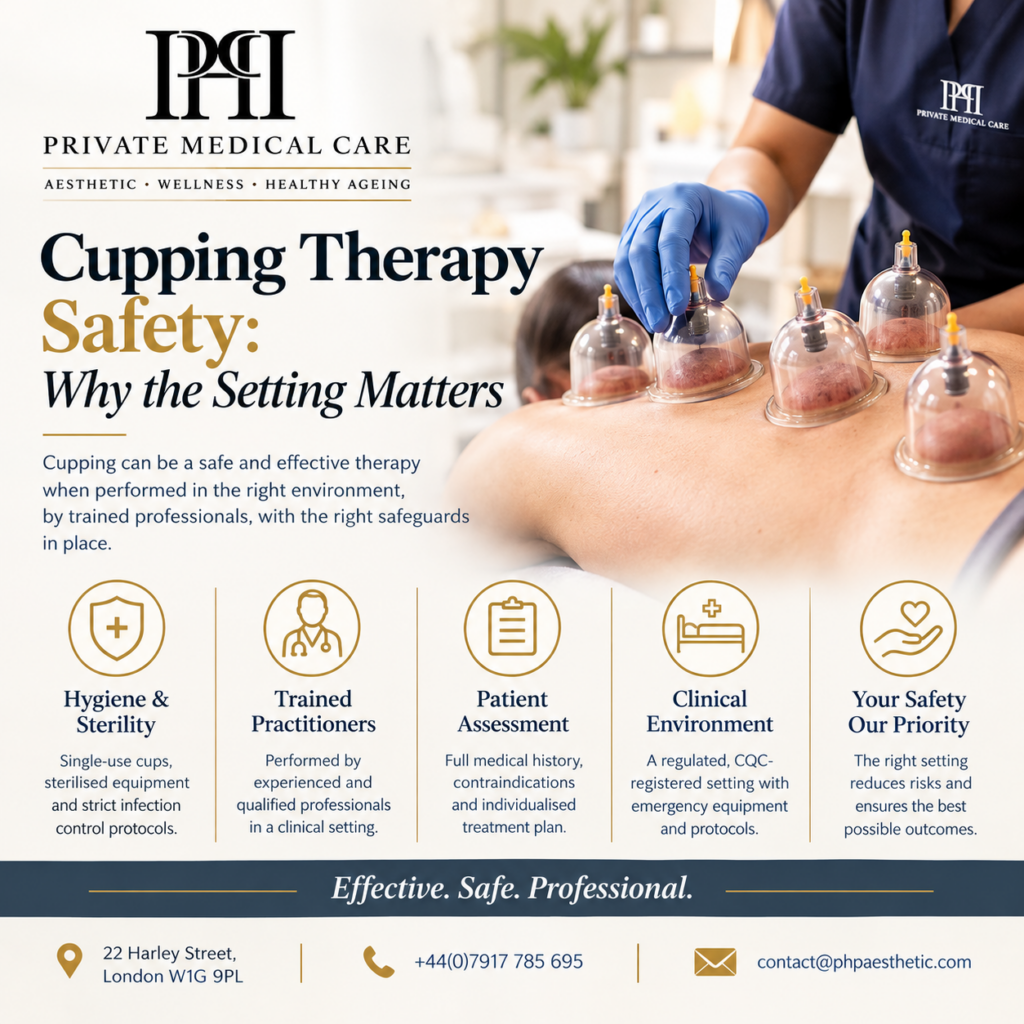
Cupping looks simple. A cup, some suction, a few minutes on a tight shoulder. It is offered in spas, gyms, beauty salons, private homes and clinics, at very different prices, and it is fair to ask whether where you have it done makes any difference.
We think it does, though not for the reason most people assume. This article sets out what a clinical setting adds, what it does not, and what to ask before you book with anyone, including us.
Start with the uncomfortable fact: cupping is not regulated
In the UK there is no statutory register of cupping practitioners. The law does not require any particular qualification, and training ranges from long supervised programmes to a single day or an online course. That is true of dry cupping and of wet cupping, also known as hijama.
It is true of us too, in one important sense. PHP Aesthetic-Wellness is registered with the Care Quality Commission for the medical services we provide. Cupping is a complementary therapy, and complementary therapies fall outside what the CQC regulates, in our clinic and in every other. Anyone who tells you their cupping is “CQC regulated” is overstating it.
So the useful question is not whether a provider is regulated. It is what standards they hold themselves to when nobody requires it.
Dry and wet cupping do not carry the same risk
In dry, massage and flash cupping the skin is never broken. The risks are modest: circular marks that fade over several days, some temporary soreness, and occasionally a blister or a burn if heat is used carelessly or cups are left on too long.
Wet cupping is different. Small superficial scratches are made in the skin and a little blood is drawn. That brings the risks of any procedure that breaks the skin: infection, scarring, fainting, and the transmission of blood-borne viruses if a blade or cup is reused or poorly cleaned. The blood and the used equipment are clinical waste and have to be handled as such.
For that reason our view is firm: wet cupping belongs in a clinical setting. Dry cupping can be done well in many places. A procedure that draws blood should only be done where sterile single-use equipment, sharps and clinical waste disposal, medical screening and proper records are already routine, as they are in a CQC-registered clinic.
What a clinical setting adds
A medical history before anyone touches you. Blood-thinning medication, a bleeding disorder, anaemia, diabetes, pregnancy and a weakened immune system all change whether cupping is sensible, and whether wet cupping should be done at all. In our clinic, wet cupping requires a written medical screen and its own consent form, separate from any other treatment.
Someone who will say no. A good practitioner declines people. We decline wet cupping, or ask you to speak to your GP first, when your history makes it unwise.
Someone who recognises when cupping is the wrong answer. Most tight shoulders are just tight shoulders. Occasionally pain or stiffness is a sign of something that needs investigating. Ours is a doctor-led clinic, and if your symptoms point that way we will tell you and refer you instead of treating you.
Infection control designed for procedures that break the skin. Single-use sterile equipment, sharps disposal, clinical waste collection and cleaning between patients are routine in a clinic because the rest of our work depends on them. They do not have to be improvised for cupping.
A record of what was done. What was treated, how, and how you responded is written into your confidential clinical record. If you have a reaction, or come back in six months, nobody is relying on memory.
A plain conversation about risk. Before you consent, you are told what can go wrong and what the evidence does and does not show.
Somewhere to turn afterwards. You leave with aftercare instructions and a number to call if the area becomes hot, increasingly painful or starts to discharge. If you are unhappy with your care, there is a written complaints procedure.
What a clinical setting does not change
It does not improve the evidence. Cupping has a long history and many people describe a real sense of release afterwards, but the published research is limited and much of it is of low quality. We offer cupping as a traditional therapy for muscular tension and comfort. It does not remove toxins, and we do not claim that it treats, cures or prevents any disease.
It does not remove the risk. Marks still appear. Wet cupping still breaks the skin. Careful practice makes complications less likely, not impossible.
And it does not mean everyone else is unsafe. There are careful, well-trained cupping practitioners working outside clinics, and a clinical address guarantees nothing by itself. Judge any provider by the answers they give you.
Seven questions to ask before you book anywhere
- What training have you had in cupping, and how long did it take?
- Will you take a medical history before you treat me?
- Who would you decline to treat? If the answer is “nobody”, be cautious.
- For wet cupping, is every blade and every cup single-use, and opened in front of me?
- How do you dispose of blood and used equipment?
- Does your insurance cover this treatment specifically?
- What should I do, and whom do I call, if the area becomes hot, painful or starts to discharge?
Be wary, too, of anyone who promises that cupping will detoxify your blood or treat an illness. Those claims are not supported by the evidence.
Cupping at 22 Harley Street
We offer dry, massage, flash and wet cupping, most often for tension in the back, shoulders and neck. Every session begins with an assessment, and the method is agreed with you before any cup is placed.
You are welcome to ask us all seven questions. Read more on our cupping therapy page.
Individual responses vary. Nothing in this article is a promise of a particular outcome or a substitute for medical advice.
Book a cupping therapy session
PHP Aesthetic-Wellness, 22 Harley Street, Suite 8, London W1G 9PL